


Eco-friendly ascorbic acid-integrated graphene oxide composite membranes for high performance ionic and molecular sieving in wastewater treatment
 b
Faheeda
Soomro,
c
Awais
Khalid,
e
Ayaz Ali
Memon,
*a
Ali
Hyder,
a
Khalid Hussain
Thebo
f
and
b
Faheeda
Soomro,
c
Awais
Khalid,
e
Ayaz Ali
Memon,
*a
Ali
Hyder,
a
Khalid Hussain
Thebo
f
and
Abstract
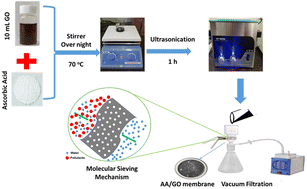
Herein, an eco-friendly GO-based composite membrane was successfully synthesized by integrating with ascorbic acid (AA). The crosslinking/bonding of GO and AA/GO composite membranes were evaluated using FT-IR technology. Surface morphology and cross-sectional investigations of the membranes were investigated by using scanning electron microscopy (SEM). The d-spacing of GO and AA/GO materials was measured using X-ray diffraction (XRD). The as-prepared membranes exhibit excellent permeability and rejection efficiency for numerous dyes and salts. The rejection efficiency and permeability of different dyes were measured as for rhodamine B (rejection 99.9% and permeance 180 ± 5 L m−2 h−1 bar−1), for methylene blue (rejection 99.7% and permeance 245 ± 5 L m−2 h−1 bar−1) and rose bengal (rejection 99.4% and permeance 270 ± 5 L m−2 h−1 bar−1). In addition, the membrane showed good separation for NaCl (rejection 87.5% and permeance 335 ± 5 L m−2 h−1 bar−1), Ni(NO3)2 (rejection 95.8% and permeance 255 ± 5 L m−2 h−1 bar−1) and Pb(NO3)2 (rejection 98.9% and permeance 170 ± 5 L m−2 h−1 bar−1). Furthermore, the as-prepared membranes are most stable in all three media up to 65 days. This approach highlights the potential practical applications of GO-based membranes in treating wastewater effluent from aqueous systems.
- This article is part of the themed collection: HOT articles from Environmental Science: Water Research & Technology
 Please wait while we load your content...


