


Bioelectrode–metal synergistic interaction for hydrogen recovery in a sulfate-reducing bacteria-based bioelectrochemical system to treat sewage wastewater: microbial dynamics and feasibility study under continuous-mode operation
 *ab
*ab
Abstract
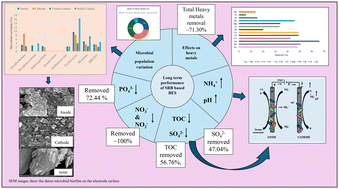
This study validated a 1 L-capacity sulfate-reducing bacteria-based bioelectrochemical system (SRB-BES) for treating sewage wastewater in continuous mode over ∼66 days. Hydrogen production of ∼50% in the SRB-BES at 1032 hours of operation indicates that sewage wastewater can be a good renewable energy source if properly harnessed. With the increase in soluble ammonia, the average TOC, SO42−, and PO43− removal efficiency of 56.76%, 47.04%, and 72.44%, respectively, was retained. An increase in pH from slightly acidic to alkaline and stabilization with the increasing sampling time results in more precipitation of toxic metal ions, causing the metal ion concentration in solution to decrease from 234.34 mg L−1 to 217.98 mg L−1 and 212.88 mg L−1, observed at 4 and 8 hours of sampling, respectively. The sulfate reducer is enriched to 4.26%, 5.38%, and 5.60% in the bioanode, biocathode, and treated culture, respectively. Thermophilic Kosmotoga at the anode (4.94%) and cathode (3.48%) indicates the possible utilization of elemental sulfur as a terminal electron acceptor at the bioelectrodes. The improved H2/CH4 ratio from 0.55 to 4.94 indicated ∼10 times SRB population activity in a mature BES. This research supports the large-scale implementation of the SRB-BES, highlighting its efficacy in treating wastewater and contributing to resource recovery at the lowest operational cost.
 Please wait while we load your content...


