


 PLATFORM UPDATE:


Hydrophobic model systems for oil film photooxidation: part I: sensitizer effects on hydrocarbon photodegradation

Abstract
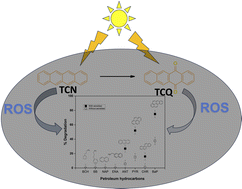
Photochemical degradation is a significant pathway controlling the fate of surface oil following marine oil spills; however, the mechanisms governing transformation in oil films remain poorly understood due to the complexity of crude oil mixtures. To address this, we optimized a hydrophobic model system with a representative polycyclic aromatic hydrocarbon (PAH) and sensitizer, specifically benzo[a]pyrene (BaP) and tetracene (TCN), and then validated it with a broader set of hydrocarbons, including both saturated compounds and PAHs. Scavenger experiments confirmed that TCN generates singlet oxygen (1O2) as the dominant oxidant, while TCN transformation products, particularly quinones, sustained photoreactivity over time. Application of the system to mixtures of hydrocarbons and crude oil showed that only larger PAHs (≥3 rings) underwent significant, sensitizer-enhanced loss. In contrast, monoaromatics, naphthalenes, and saturated compounds remained stable under the studied conditions. Replacing TCN with crude oil as a sensitizer mirrored the degradation pattern observed in the TCN-based system, validating the role of indirect photooxidation in petroleum. These results indicate that indirect, sensitizer-driven pathways selectively control the transformation of PAHs in oil films and that evolving sensitizer pools prolong photoreactivity. Overall, the model system provides a tractable framework for dissecting hydrocarbon-class-specific oil photooxidation mechanisms in a homogeneous hydrophobic phase.
- This article is part of the themed collection: Transformation products, mixtures, and vectors
 Please wait while we load your content...


