


 PLATFORM UPDATE:

Redistribution of cadmium in soil aggregates under continuous carbon and nitrogen inputs: insights from sequential extraction and modeling
 *a
*a
Abstract
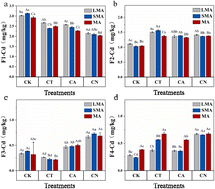
Continuous carbon (C) and nitrogen (N) inputs significantly affect cadmium (Cd) redistribution in soil aggregates, yet their impacts remain poorly understood. This study investigates Cd redistribution under labile C and two N sources (glucose + nitrate [CN], glucose + ammonium [CA], and glucose alone [CT]). CN and CA treatments increased Fe and Mn oxide-bound Cd (F3-Cd) by 99.7% and 38.7% in bulk soil, respectively, while CT reduced F3-Cd by 33.1%. Increased dissociative Fe oxides (DCB-Fe) and decreased Fe2+, coupled with NO2− consumption, confirmed enhanced NO2− reduction and Fe2+ oxidation in F3-Cd formation. Carbonate-bound Cd (F2-Cd) and organic matter-bound Cd (F4-Cd) also increased significantly (42.0–121.5%) across all treatments. Feature importance analysis highlighted dissolved organic carbon (DOC) as a key driver for F2-Cd, while DOC, amorphous Fe (oxalate-Fe), and soil organic carbon (SOC) influenced F4-Cd. Micro-aggregates (MAs) had higher F4-Cd levels compared to large macro-aggregates (LMAs) and small macro-aggregates (SMAs). Partial least squares path modeling showed that DOC influenced F2-Cd in LMAs, nitrate and ammonium cycling affected F3-Cd in SMAs, and genes related to Fe cycling and nitrification drove F4-Cd in MAs, potentially impacting mineral-associated SOC. Understanding C and N inputs' effects on Cd redistribution can improve remediation strategies for Cd pollution in agricultural soils.
 Please wait while we load your content...


