


Ultrasmall MoC-supported PtRu clusters with boosted HOR activity and CO tolerance via metal–support interaction

Abstract
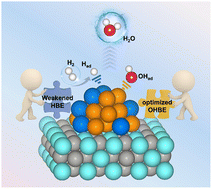
The commercialization of the anion exchange membrane fuel cell (AEMFC) is hindered by the sluggish hydrogen oxidation reaction (HOR) kinetics in alkaline environments and poor CO tolerance. Metal–support interaction (MSI) is widely used to improve activity and stability by tuning the electronic structures and adsorption energies. Based on certain limitations in enabling the effective utilization of MSI under the HOR-relevant conditions for the previously reported transition metal carbide (TMC) support, we synthesized a series of alkaline HOR catalysts by loading platinum-group metal (PGM = Pt, Ru, and PtRu alloys) nanoclusters on an ultrasmall MoC (2.2 ± 0.5 nm) support. The ultrasmall MoC support achieves a strongly anchored and high-density PGM–MoC contact interface with improved metal utilization and excellent dispersion to achieve higher HOR activity and stability with superior CO tolerance. Notably, the as-prepared Pt1Ru2/MoC catalyst demonstrates a remarkably high exchange current density (3.09 mA cm−2) and mass activity (3.88 A mg(Pt + Ru)−1) in alkaline media, which are 4.8 and 11.1 times higher than those of commercial Pt/C, respectively. A mechanistic study reveals that the ultrasmall MoC-induced MSI quantitatively optimizes the *H and *OH adsorption and the HOR reaction pathway while weakening CO adsorption and facilitating CO removal. In addition, the strong anchoring effect of the MoC support facilitates the formation of a robust hydrogen bond network, which accelerates proton shuttling and enhances the coupling between *H and *OH species via the Grotthuss mechanism, thereby significantly boosting the alkaline HOR kinetics. Through comprehensive experimental and theoretical investigations, we systematically elucidate the MSI mechanism in this system, thereby providing deeper insights and experimentally verifiable design principles for the development of high-performance MoC-supported catalysts in the alkaline HOR.
 Please wait while we load your content...


