


 PLATFORM UPDATE:


Intrinsic reversibility in Ir-based electrocatalysts via dynamic segregated-surface reconstruction
 †a
Gogwon
Choe,
a
Sang-Mun
Jung,
a
Sarah S.
Park,
d
Jeong Woo
Han,
*b
Kug-Seung
Lee
*e
and
Yong-Tae
Kim
*a
†a
Gogwon
Choe,
a
Sang-Mun
Jung,
a
Sarah S.
Park,
d
Jeong Woo
Han,
*b
Kug-Seung
Lee
*e
and
Yong-Tae
Kim
*a
Abstract
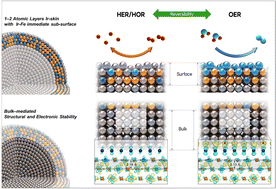
Electrocatalysts are frequently exposed to undesired oxidation, leading to irreversible passivation that severely impairs their catalytic activity and stability. Despite exhibiting excellent intrinsic activity, many electrocatalysts have been limited in practical application due to their susceptibility to oxidation and the irreversible loss of activity once oxidized. To overcome these challenges, this study demonstrates a novel approach to achieving reversibility via the IrFe/C electrocatalyst, which dynamically regenerates its metallic state after oxidation, thereby sustaining high catalytic performance. This reversibility is achieved through decoupling the catalyst's surface from its bulk—while the robust metallic alloy core remains intact, the surface independently reconstructs in response to varying electrochemical demands. Furthermore, when applied in practical water electrolyzers and fuel cells, the IrFe/C catalyst effectively suppresses irreversible degradation, maintaining high current densities (1.56 A cm−2) and peak power densities (0.72 W cm−2) under harsh transient conditions, whereas conventional systems suffer catastrophic failure (dropping to 0.74 A cm−2 and 0.12–0.25 W cm−2, respectively). Collectively, our study introduces a new paradigm for overcoming surface passivation, offering a sustainable strategy that promotes facile recovery and fundamentally addresses the critical bottleneck of electrocatalyst durability.
 Please wait while we load your content...


