


 PLATFORM UPDATE:


SO2-tolerant electrochemical CO2 capture and NaHCO3 conversion enabled by saline water electrolysis

Abstract
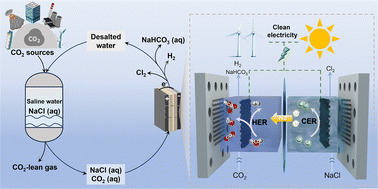
Electrochemical carbon capture offers a sustainable route to mitigate CO2 emissions, but practical deployment is often limited by modest capture rates and system complexity. Here we report a saline–water electrolysis strategy that simultaneously captures CO2 and converts it to sodium bicarbonate (NaHCO3) without external chemical additives. Hydroxide ions (OH−) generated in situ at the cathode via the hydrogen-evolution reaction (HER) enable rapid CO2 absorption and selective conversion to NaHCO3 by maintaining the catholyte at pH 8–9, consistent with thermodynamic speciation. In simulated flue gas, the system delivers a CO2 capture rate of 5.27 mmolCO2 cm−2 h−1 (55.6 kgCO2 m−2 day−1) at 300 mA cm−2, >99.5% capture efficiency, >90% faradaic efficiency, and energy consumption as low as 87 kJ molCO2−1 (1.98 GJ tCO2−1). The process is tolerant to sulfur dioxide (SO2), maintaining ∼85% NaHCO3 conversion for >240 h with 1.0% SO2 in the feed. Using pure water as the catholyte enables direct production of high-purity NaHCO3, enhancing operational flexibility. Techno-economic analysis indicates capture costs with US$90.3 per tCO2 when co-located with a desalination facility and low-cost electricity, while considering the revenues from products NaHCO3, H2 and Cl2 can further improve the economics. This multifunctional, impurity-resistant, and renewable-compatible approach offers a practical, scalable pathway for industrial CO2 capture and mineralization.
 Please wait while we load your content...


