


 PLATFORM UPDATE:


Synergizing Ag alloying and urchin-like structure to steer formic acid oxidation toward the direct pathway on Pt nanocrystals in acidic medium

Abstract
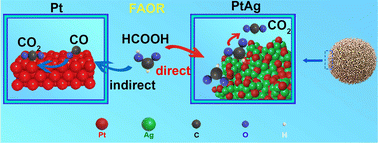
Developing efficient and CO-tolerant electrocatalysts for formic acid oxidation remains a critical challenge due to the sluggish kinetics and severe CO poisoning of Pt-based catalysts. Herein, we report a facile synthesis of urchin-like PtAg nanocrystals (PtAg NUs) with a densely branched architecture, which synergizes Ag alloying and unique morphological features to steer the reaction toward the direct pathway. When assessed for formic acid oxidation in acidic medium, PtAg NUs exhibit significantly enhanced performance compared to commercial Pt/C. Specifically, PtAg NUs show a lower onset potential (320 vs. 430 mV), a 17.6-fold higher direct pathway specific activity (0.88 vs. 0.05 mA cm−2), and a 3.9-fold higher indirect pathway specific activity (0.66 vs. 0.17 mA cm−2). Most notably, PtAg NUs demonstrate enhanced long-term stability, retaining nearly six times higher current after 3600 s (0.035 vs. 0.006 mA cm−2). In situ Raman spectroscopy confirms that both direct and indirect pathways coexist, with Ag alloying steering the reaction toward a more direct pathway-dominant process. Density functional theory reveals that Ag alloying downshifts the d-band center, weakening CO adsorption and facilitating the COOH*-mediated pathway. The enhanced performance is attributed to the synergistic interplay of Ag electronic modification and the urchin-like geometric effects. This work highlights how synergizing Ag alloying and morphological engineering can steer formic acid oxidation toward the direct pathway, offering a rational design strategy for advanced Pt-based electrocatalysts.
 Please wait while we load your content...


