


 PLATFORM UPDATE:


Stereochemical control and its consequences in VO(acac)2 complexes: an integrated study of trans/cis isomerism with quinoline and isoquinoline

Abstract
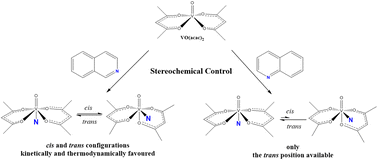
In this study, a combination of experimental and theoretical methods was applied to rigorously characterize the factors controlling the stereochemistry of three novel adducts: VO(acac)2(trans-quinoline) (1), VO(acac)2(trans-isoquinoline) (2), and VO(acac)2(cis-isoquinoline) (3). Based on X-ray measurements, spectroscopic analysis (IR and UV-Vis) and density functional theory (DFT) calculations, it was demonstrated that the coordination mode is predominantly governed by steric factors. While the trans isomer is favoured both kinetically and thermodynamically in most cases, the cis isomer becomes viable when the favourable geometry of the ligand offsets the inherent steric and entropic penalties, as shown for isoquinoline. Electronic structure analysis revealed that cis coordination enhances σ-donation to the vanadium center, resulting in a stronger, more polarized V–N bond, a red-shifted V![[double bond, length as m-dash]](https://www.rsc.org/images/entities/char_e001.gif) O stretching frequency, and a blue-shifted d–d transition. These findings establish clear structure–property relationships linking ligand architecture to coordination geometry, electronic structure, and thermal stability. The insights gained provide a predictive framework for the rational design of VO(acac)2-based complexes with tailored stereochemistry and optimized properties for applications in catalysis, materials science, and bioinorganic chemistry.
O stretching frequency, and a blue-shifted d–d transition. These findings establish clear structure–property relationships linking ligand architecture to coordination geometry, electronic structure, and thermal stability. The insights gained provide a predictive framework for the rational design of VO(acac)2-based complexes with tailored stereochemistry and optimized properties for applications in catalysis, materials science, and bioinorganic chemistry.
 Please wait while we load your content...


