


 PLATFORM UPDATE:


Recent advances in the development of optical chemosensors and chemodosimeters for the recognition of Hg2+
 *a
*a
Abstract
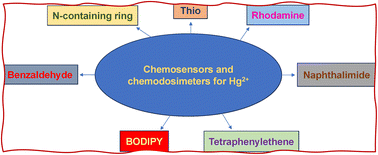
Mercury is one of the most harmful elements. It is commonly present as Hg2+ ions. Its presence in the human body causes several health issues. Its detection by colorimetric and fluorogenic methods has been achieved by several research groups by the use of chemosensors and chemodosimeters. These chemosensors were constructed from several fluorophores, such as rhodamine, coumarin, tetraphenylethene, and quinoline. The presence of thio functionalities in them provides another opportunity for the recognition of the metal ion. This is possible using either chemosensors with a reversible binding nature or chemodosimeters where structural changes occur with breaking and forming several covalent bonds irreversibly. The presence and interaction of Hg2+ with the probes cause significant alterations in their photophysical properties, enabling their application as sensors for the cation. About 135 recently published research articles are included for discussion. This discussion provides the recent progress in the development of chemosensors and chemodosimeters for the detection of Hg2+. At the end, future prospects in this research field are discussed.
 Please wait while we load your content...


