


 PLATFORM UPDATE:


Optimization of Fe(iii)-based negative electrodes for lithium-ion batteries: probing electrochemical performance and stability characteristics
 c
Subrata
Chakraborty
*ad
c
Subrata
Chakraborty
*ad
Abstract
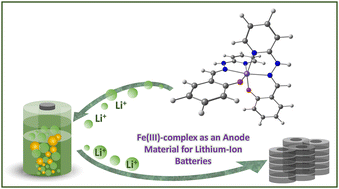
The development of inexpensive and sustainable electrode materials is essential for advancing next-generation lithium-ion batteries (LIBs). In this study, we report an investigation of an Earth-abundant Fe(III)-based molecular complex incorporating a hydrazyl pyridine framework (C-1) as an anode material for LIB applications. The synthesized C-1 electrode delivers a promising initial discharge capacity of 1182.18 mAh g−1 and a reversible charge capacity of 384.27 mAh g−1 with an initial coulombic efficiency of 32.5%. The discharge profile subsequently shows a stable, reversible capacity of 393.40 mAh g−1, confirming efficient lithium-ion storage within the molecular framework. Furthermore, the electrode shows a moderate rate capability, a reversible capacity of 113.40 mAh g−1 after 100 cycles, and a stable coulombic efficiency during long-term cycling. The observed electrochemical behaviour indicates that the hydrazyl-pyridine-coordinated Fe(III) architecture is structurally robust and promotes charge transport during repeated lithiation/delithiation processes. We demonstrate that Fe-based molecular complexes could be promising, affordable, and chemically tunable candidate electrodes, opening up avenues for sustainable and low-cost energy storage solutions.
 Please wait while we load your content...


