Dual-tuning birefringence in hybrid crystals via Cd/Zn metal center and organic ligand isomerism

Abstract

This study compares three hybrid crystals. (C9H7NBr)CdCl3·H2O exhibits the highest birefringence (0.405@550 nm) due to distorted polyhedra and parallel organic alignment. Organic ligand branch isomerism maintains birefringence via denser packing, whereas Zn2+ substitution reduces it by canceling polarization vectors, providing a strategy for the fabrication of superior hybrid optical crystals.
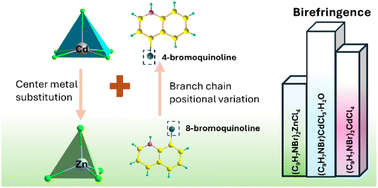
Graphical abstract: Dual-tuning birefringence in hybrid crystals via Cd/Zn metal center and organic ligand isomerism

Supplementary files

Article information

Article type
Communication
Submitted
21 Feb 2026
Accepted
16 Apr 2026
First published
24 Apr 2026

Dalton Trans., 2026, Advance Article

Dual-tuning birefringence in hybrid crystals via Cd/Zn metal center and organic ligand isomerism

Y. Shen, X. Wang, M. Wu, Y. Yang and L. Yan, Dalton Trans., 2026, Advance Article , DOI: 10.1039/D6DT00452K

To request permission to reproduce material from this article, please go to the Copyright Clearance Center request page.

If you are an author contributing to an RSC publication, you do not need to request permission provided correct acknowledgement is given.

If you are the author of this article, you do not need to request permission to reproduce figures and diagrams provided correct acknowledgement is given. If you want to reproduce the whole article in a third-party publication (excluding your thesis/dissertation for which permission is not required) please go to the Copyright Clearance Center request page.

Read more about how to correctly acknowledge RSC content.

Social activity

Spotlight

Advertisements