


Deciphering the atomic-scale evolution pathway of Keggin-type aluminum nanoclusters in aqueous media

Abstract
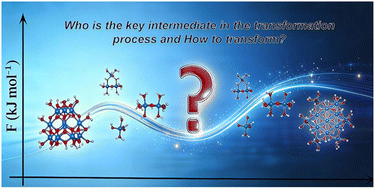
The atomic-scale understanding of aluminum polyoxocation cluster configurational evolution in precursor solutions is essential for rationally designing aluminum-based functional materials. This study investigates the transformation of metastable Keggin-type ε-[Al13O4(OH)24(H2O)12]7+ (ε-Al13) to planar [Al13(OH)24(H2O)24]15+ (Flat-Al13), which is the pivotal step in crystalline hydroxide formation with previously unelucidated dynamics. Spectral tracking of the induced synthesis of Flat-Al13 from ε-Al13 solution elucidated the intrinsic driving role of the proton. Subsequent biased ab initio molecular dynamics (AIMD) simulations revealed solvent-mediated kinetics during Keggin-to-planar reconstruction, identifying Cage-Al10 as a key metastable intermediate and, importantly, capturing evidence for its existence. Furthermore, by controlling the surface protonation state, it was demonstrated that the local H+ concentration can modulate the competitive balance between dissociation and reconstruction through regulating the Al–O bond strength, enabling targeted control of cluster dissociation and configurational transformation. These findings establish a mechanistic framework for steering aluminum polyoxocation transformations, with direct implications for the optimized design of advanced aluminum-based functional materials.
 Please wait while we load your content...


