


 PLATFORM UPDATE:


Dual-sensitized luminescent Eu(iii) dosimeter for the selective detection of inorganic phosphates via a ligand displacement mechanism

Abstract
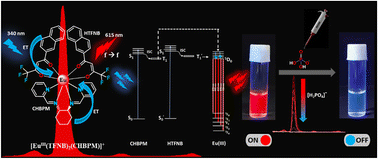
Phosphates play pivotal roles in numerous critical biological processes. They encompass crucial biomolecules, such as phosphorylated amino acids, nucleotide phosphates, phosphoesters, phosphorylated proteins, and phospholipids, which utilize inorganic phosphates (Pi) during their biosynthesis. Dysregulation of the phosphate levels has been implicated in various chronic and acute renal diseases. Therefore, the precise detection and quantification of phosphates hold paramount importance for disease diagnosis, drug development, and physiological assessment. Luminescent lanthanide-based sensors have emerged as a promising avenue for physiological phosphates due to their unique photophysical properties, originating from f–f transitions, and favourable binding thermodynamics via strong ionic interactions, thereby surpassing their traditional organic counterparts and transition-metal complexes. This study introduces (Eu(TFNB)2(LN4))(OTf) [Eu.1] as a luminescent Eu(III) probe designed for the detection of inorganic phosphate (Pi) via displacement of the weaker binding neutral ligand (LN4) by the stronger binding phosphate anion. The dual-sensitized Eu(III) probe contains a neutral nitrogen-rich Schiff base (LN4) (N,N′-cyclohexanediyl-bis-2-pyridinyl-methanamine) and two anionic β-diketonate (trifluoro-naphthyl-butanedionate, TFNB) units. The Eu.1 probe was extensively characterized using various physicochemical and spectroscopic techniques to establish its molecular structure, solid and solution stability, and photoluminescence behavior. The characteristic red luminescence, originating from the 5D0 → 7FJ f–f transitions in the Eu.1 probe, was utilized as the optical signal to detect inorganic phosphates along with other interfering anions via quantitative luminescence titrations. Detailed binding studies suggest that significant luminescence quenching of Eu.1 with H2PO4− operates via a competitive ligand dissociative mechanism due to the thermodynamically favorable strong hard–hard electrostatic interactions between the Eu(III) ion and H2PO4−, enabling rapid and selective phosphate sensing at nanomolar (nM) concentrations. The comprehensive spectroscopic methods confirm the binding stoichiometry, affinity, selectivity and high sensitivity of the Eu.1 probe for inorganic phosphates in solution.
 Please wait while we load your content...


