


Computational insights into the role of oxidation state in C–H activation by high-valent iron and manganese oxo oxidants

Abstract
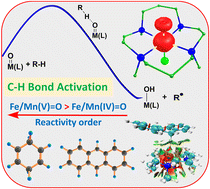
High-valent metal-oxo species play a pivotal role as intermediates in the activation of C–H, O–H and N–H bonds. Their reactivity is influenced by several factors, including the oxidation state, spin state and steric/electronic properties of the ligands. In this study, we explore the electronic structures of 14-TMC-ligated iron and manganese-oxo species in two oxidation states (IV and V) and provide a comparative analysis of their oxidative capabilities toward C–H bond activation. The computed potential energy surfaces of iron/manganese with the 14-TMC reveal that higher oxidation states correspond to greater reactivity. Frontier orbital analysis and molecular electrostatic potential maps suggest that the species with higher oxidation states have lower energy gaps and more negative potentials, which correlate with the increased reactivity. This trend is further supported by structural correlations at the transition states, calculated M–O/M–Cl bond length ratios, electron acceptor orbitals, noncovalent interaction and energy decomposition. Furthermore, the iron-oxo species demonstrate higher reactivity than the corresponding manganese-oxo species due to their exchange-enhanced reactivity. These findings highlight the importance of understanding metal d-electron exchange and structural changes at the transition states to design more efficient and selective catalysts for C–H activation reactions.
 Please wait while we load your content...


