


 PLATFORM UPDATE:


Tailoring LiPF6-based electrolyte solvation structures via solvent regulation strategies for low-temperature lithium metal batteries
 *a
Minghua
Chen
a
*a
Minghua
Chen
a
Abstract
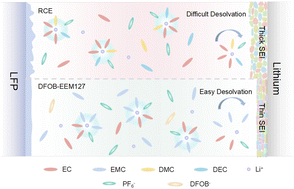
Lithium metal batteries (LMBs) offer exceptional energy density, yet their practical application is limited by unstable solid electrolyte interphase (SEI) formation and sluggish Li+ transport, particularly under low-temperature conditions. Here, a carbonate electrolyte employing a cosolvent and dual-salt strategy is proposed to simultaneously tailor the Li+ solvation and interfacial chemistry of LiPF6-based electrolytes. The introduction of ethyl methyl carbonate weakens the strong Li+–ethylene carbonate coordination, while difluoro(oxalato)borate anions preferentially undergo interfacial reduction to construct a robust, inorganic-rich SEI. This tailored solvation environment affords a low Li+ diffusion energy barrier and effectively suppresses lithium dendrite formation. As a result, the electrolyte delivers exceptional low-temperature performance, achieving an ionic conductivity of 1.013 mS cm−1 at −30 °C and a reduced desolvation energy of 66.84 kJ mol−1. High-loading LFP∥Li full cells exhibit a specific capacity of 163.06 mAh g−1 at 0.2C and retain over 80% capacity after 200 cycles at 25 °C. Even at −30 °C, the cells maintain 58% capacity retention after 100 cycles. This work highlights the interplay between solvation chemistry, SEI composition, and interfacial ion transport, offering a viable design paradigm for high-performance carbonate electrolytes in low-temperature LMBs.
 Please wait while we load your content...


