


 PLATFORM UPDATE:


LDH-mediated interfacial redox formation of δ-MnO2 phyllomanganate from KMnO4: mechanistic insights and subsequent fluorination pathways

Abstract
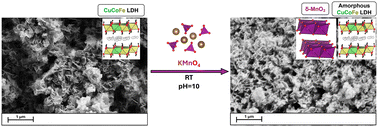
Thanks to their versatile chemical composition, layered double hydroxides (LDHs) containing only 3d ions as intralamellar cations (Co2+, Cu2+, and Fe3+), when brought into contact with a potassium permanganate solution, lead to the formation of δ-MnO2 phyllomanganate, concomitant with the decomposition of the LDH matrix. This green chemistry route is explained by the oxidation of Co2+ cations, resulting in the reduction of the permanganate anion MnO4− and, consequently, the breakdown of the LDH structure due to excess charge. Thermodynamically favored in alkaline solution, the reaction can be considered as a transformation initiated at the interface and assisted by a redox reaction. The use of cobalt nitrate instead of LDH-Co2+ leads to the formation of another manganese oxide polymorph: λ-MnO2, which is non-lamellar but exhibits a three-dimensional spinel structure. The fluorination reaction reveals the role of Co2+ cations: they remain in the same oxidation state after treatment at 350 °C under F2, while they are completely oxidized to Co3+ after the LDH template comes into contact with the KMnO4 solution. The materials are characterized at each step of the reaction, including contact and subsequent fluorination reactions by a combination of solid-state techniques, notably Raman and 57Fe Mössbauer spectroscopies and XRD pattern refinement. Furthermore, gas–solid fluorination proves to be a sensitive redox and structural probe, highlighting the oxidation state of cobalt and the presence of preformed Mn(IV) species, and also suggesting that the phyllomanganate formation mechanism is a reaction at the LDH interface. This novel approach paves the way for the preparation of intimately mixed redox materials for electrochemical applications.
- This article is part of the themed collection: Inorganic Nanomaterials
 Please wait while we load your content...


