


A-site Ca substitution optimizing SrCoO3−δ phase structure and B-site environment for efficient oxygen evolution
 *ab
*ab
Abstract
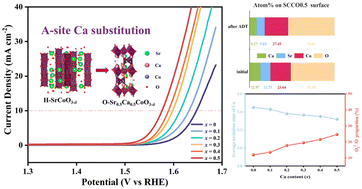
SrCoO3−δ has been regarded as a promising electrocatalyst for the oxygen evolution reaction (OER) owing to its superior structural tunability and elemental flexibility. However, the regulation of the B-site local environment and phase structure by A-site ions remains underexplored. Herein, a series of Sr1−xCaxCoO3−δ (x = 0, 0.1, 0.2, 0.3, 0.4, 0.5) (SCxCO) catalysts have been synthesized via a sol–gel method. The introduction of Ca2+ induces the transformation from the hexagonal (x = 0, P63/mmc) to the orthorhombic (x = 0.3–0.5, Imma) crystal structure while optimizing the electronic structure of B-site Co ions. Here, “Co environment modulation” refers to Ca-induced phase control (hexagonal → orthorhombic) with concurrent Co valence tuning and vacancy-associated distortion, as supported by XRD/Rietveld, Raman, and XPS analyses and titration. Among them, the orthorhombic Sr0.5Ca0.5CoO3−δ exhibits the best OER performance with an overpotential of 336 mV at 10 mA cm−2 (1 M KOH), which further decreases by 41 mV after 1000 CV cycles. Ca doping suppresses surface Sr enrichment to expose B-site Co ions, while simultaneously optimizing the Co3+/Co4+ ratio by lowering the average oxidation state from +3.45 (Co3+/Co4+ ≈ 1.22) to +3.30 (Co3+/Co4+ ≈ 2.33). The resulting orthorhombic structure facilitates the generation of oxygen vacancies and highly oxidative oxygen species (O22−/O−), as well as the formation of surface CoOOH to significantly boost OER kinetics. This work reveals the critical role of A-site Ca doping in modulating the crystal structure and B-site environment in perovskite oxides, providing new insights for the rational design of efficient OER catalysts.
 Please wait while we load your content...


