


Preparation of a carbon quantum dot-embedded silica microsphere/terbium composite for dual-ratiometric fluorescence detection of MnO4− ions
 *a
*a
Abstract
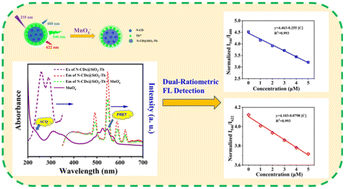
In this study, a dual-ratiometric fluorescent probe based on an N-doped carbon dot-embedded silica microsphere/terbium composite (N-CDs@SiO2-Tb) was successfully fabricated for the selective and sensitive detection of permanganate ions (MnO4−) in aqueous media. Under 235 nm excitation, the composite exhibited multi-emission peaks at 400 nm (N-CDs) and 546/622 nm (Tb3+), along with excellent dispersibility in water. Notably, MnO4− induced differential quenching of the 546 and 622 nm emissions (more significant at 546 nm), while the 400 nm emission remained stable, allowing the establishment of two ratiometric signals (I546/I400 and I546/I622). Sensitivity tests indicated that both ratios had good linearity with MnO4− concentration (0–5 μM) and low detection limits (0.12 μM and 0.13 μM). The quenching mechanism was related to the synergistic effect of absorption competition quenching (ACQ) and Förster resonance energy transfer (FRET), where FRET was responsible for the differential quenching at 546 nm. This self-referencing dual-ratiometric strategy enables cross-validation of the dual readout signals, effectively suppressing external interferences (notably Cr2O72−) and ensuring high accuracy in complex matrices. Consequently, N-CDs@SiO2-Tb exhibits exceptional sensitivity coupled with a reliable self-calibration capacity and real-time response, which endow it with great potential for the accurate detection of MnO4− in environmental water samples.
- This article is part of the themed collection: Inorganic Nanomaterials
 Please wait while we load your content...


