


 PLATFORM UPDATE:


Constructing robust Si–Ni alloy/carbon nanofiber composites for high-rate lithium-ion battery anodes

Abstract
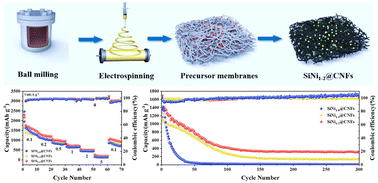
Silicon is a promising anode candidate for high-energy-density lithium-ion batteries, yet its practical application is hindered by severe volume expansion and poor electrical conductivity. To address these challenges, a synergistic alloy-carbon strategy was proposed. Specifically, a hierarchical structure was designed by combining ball milling with electrospinning, where Si–Ni alloy nanoparticles are uniformly embedded within nitrogen-doped carbon nanofibers (SiNi@CNFs). In this architecture, the inactive Ni phase serves as an internal buffer to absorb volumetric stress and simultaneously builds a conductive network. Externally, the crosslinked carbon fibers provide mechanical confinement and facilitate rapid ion transport pathways. This coupling effectively enhances both structural stability and reaction kinetics. Consequently, the optimized SiNi1–2@CNFs electrode delivers a high reversible capacity of 806.9 mAh g−1 at 1 A g−1. This work demonstrates a practical engineering approach to mitigate the expansion issues of silicon anodes, offering valuable insights for developing high-performance energy storage devices.
 Please wait while we load your content...


