


Enhancing the bifunctional and overall water splitting electrocatalytic activity of copper MOFs by integrating conductive rGO

Abstract
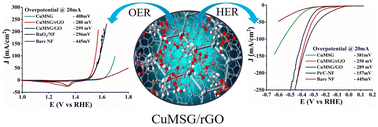
The electrocatalytic water splitting activity of metal–organic frameworks (MOFs) can be optimized/enhanced by tailoring the coordination environments and fabricating composites using conductive materials. Herein, a water-coordinated copper (Cu) MOF was synthesized using monosodium glutamate (MSG), and its bifunctional electrocatalytic activity in an alkaline medium was improved by integrating conductive rGO. Single-crystal structure analysis confirmed the formation of a 3D network structure with a water coordination. Electrocatalytic studies of CuMSG showed relatively weak activity in both the hydrogen evolution reaction (HER) and oxygen evolution reaction (OER). The MOF required overpotentials of 381 and 408 mV to achieve 20 mA cm−2 current density. However, the electrocatalytic activity of CuMSG was strongly enhanced by fabricating a composite with conductive rGO, which required low overpotentials of 250 and 280 mV to produce 20 mA cm−2 current density in the HER and OER, respectively. After combining with rGO, CuMSG showed low Tafel slope (128 (HER) and 48 mV dec−1 (OER)), indicating improved kinetics at the electrode-catalyst interface. The integration of rGO with CuMSG also reduced the charge-transfer resistance (2.86 (HER) and 3.38 Ω (OER)), which also contributed to enhanced bifunctional electrocatalytic activity. The bifunctional electrocatalytic activity of CuMSG–rGO was utilized for overall water splitting, and it required a cell potential of 1.72 V to achieve 10 mA cm−2 current density. The CuMSG–rGO electrocatalyst displayed good stability over 20 h in the OER, HER and overall water splitting.
 Please wait while we load your content...


