


 PLATFORM UPDATE:


Tailoring in-gap states for optimizing the band gap in mixed-valent bromometallates, towards lead-free photovoltaics
 bc
Denis A.
Pankratov,
a
Alexey N.
Kuznetsov,
ae
Sergey Z.
Vatsadze
ab
and
Andrei V.
Shevelkov
*a
bc
Denis A.
Pankratov,
a
Alexey N.
Kuznetsov,
ae
Sergey Z.
Vatsadze
ab
and
Andrei V.
Shevelkov
*a
Abstract
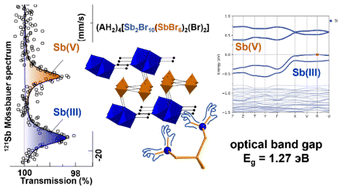
Motivated by the task to replace toxic lead halide perovskites with lead-free environmentally benign light-harvesting materials for photovoltaics, we have synthesized two new hybrid bromometallates, (AH2)4[Sb2Br10(SbBr6)2(Br)2] (1) and (AH2)2[(BiBr6)(SbBr6)]·2H2O (2), where A = 1,5-dimethyl-3,7-diazabicyclo[3.3.1]nonane. Their crystal structures show combinations of Sb3+/Sb5+ (1) or Bi3+/Sb5+ (2) centers each surrounded by six Br− anions forming distorted (Sb3+ or Bi3+) or almost regular (Sb5+) octahedra. These octahedra are arranged in the crystal structure in a perfectly ordered way owing to weak Br⋯Br interactions within the inorganic anionic part and to hydrogen bonds linking inorganic anions and organic cations. The electronic structures of both compounds are alike in that they have M3+/Br− states (M = Sb or Bi) dominating the top of the valence band and acceptor in-gap states formed by the Sb5+/Br− interactions. Such an electronic structure leads to the reduced band gap of 1.27 (1) and 1.58 eV (2), favorable for creating light-harvesting materials for photovoltaics. We support our data by powder and single-crystal X-ray diffraction study, 121Sb Mossbauer spectroscopy, and optical spectroscopy. We infer that tailoring the band gap is a very important step on the way to lead-free light-harvesting materials for photovoltaic applications.
 Please wait while we load your content...


