


 PLATFORM UPDATE:


Enhancing the ORR activity of Fe-based perovskite cathodes for intermediate-temperature solid oxide fuel cells: alternative strategies and performance optimization

Abstract
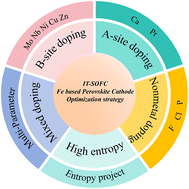
Solid oxide fuel cells (SOFCs) have attracted much attention due to their high efficiency and environmental friendliness. However, high operating temperatures lead to material degradation, which limits their application. When the temperature is reduced to an intermediate range (600–800 °C), the kinetics of the cathode oxygen reduction reaction (ORR) becomes the performance bottleneck. Iron-based perovskite cathodes, with advantages including low cost and structural stability, are strong alternatives to cobalt-based materials. However, their ORR activity is insufficient due to the limited generation and migration of oxygen vacancies. This review comprehensively summarizes recent advances in performances enhancement strategies for iron-based perovskite cathodes, including A-site and B-site doping, high-entropy design, and non-metal anion doping. We particularly highlight the underlying mechanisms through which these strategies synergistically optimize the electronic structure, enhance oxygen ion transport, and accelerate surface reaction kinetics. Finally, we provide perspectives on future research directions, emphasizing the critical role of in situ characterization combined with theoretical modeling for mechanistic insights, and the potential of novel structural engineering paradigms to guide the rational design of high performance, durable cathodes for intermediate-temperature SOFCs.
- This article is part of the themed collection: 2026 Frontier and Perspective articles
 Please wait while we load your content...


