


Unraveling the role of Se defects in Fe3Se4 for the electrocatalytic oxygen evolution reaction

Abstract
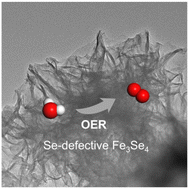
The high cost of catalysts remains a major bottleneck for water electrolysis hydrogen production, making the development of cost-effective and efficient non-precious-metal catalysts an urgent priority. In this study, we synthesized selenium vacancy-rich iron selenide (Fe3Se4) through an electro-precipitation method. Combined theoretical calculations and experimental characterization confirm that these selenium vacancies serve as highly efficient active sites, effectively modulating the local electronic structure of Fe centers and optimizing their adsorption behavior toward reaction intermediates. In the oxygen evolution reaction (OER), this defective structure significantly enhances water molecule adsorption and dissociation while minimizing the activation energy barrier of the rate-determining step. Benefiting from these features, the Se-deficient Fe3Se4 catalyst exhibits high OER performance, requiring only 274.8 mV overpotential to achieve 50 mA cm−2 while demonstrating remarkable stability for 100 h at 100 mA cm−2, highlighting its rapid OER kinetics.
 Please wait while we load your content...


