


 PLATFORM UPDATE:

Recent advances in selectivity control for the catalytic reduction of functionalized nitroarenes over metal-based catalysts
 †a
and
Mingjun
Jia
*a
†a
and
Mingjun
Jia
*a
Abstract
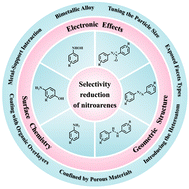
Catalytic reduction of functionalized nitroarenes is a key process for producing various valuable nitrogen-containing aromatic compounds, including substituted hydroxylamines, azoarenes, azoxyarenes, hydrazoarenes, anilines, p-aminophenol and so on. During the past decades, considerable efforts have been devoted to designing and preparing highly efficient metal catalysts for the selective reduction of nitroarenes with hydrogen or other eco-friendly reducing agents. However, in many cases, achieving high selectivity control without compromising activity and stability (recyclability) is quite challenging mainly due to the presence of competing reducible groups and different hydrogenation pathways. With continuous innovations in catalyst design and process optimization, a number of highly active catalyst systems with high specific selectivity have been obtained recently, demonstrating the great design space in both academic studies and industrial applications. In this perspective, we summarize recent advances in the fine control of the selectivity of various metal nanoparticle, cluster, single-atom and composite catalysts for nitroarene reduction; this is commonly conducted by tuning the electronic and geometric structures of the active metal centers, and by optimizing the surface chemistry of the metal catalysts. The main contents are focused on innovative designs for constructing novel catalyst systems to improve the selectivity toward a specific target product, and on understanding the control mechanism. Finally, the current challenges and future directions are presented in order to provide a holistic perspective on the development of advanced production technologies for the selective reduction of functionalized nitroarenes.
- This article is part of the themed collection: 2026 Frontier and Perspective articles
 Please wait while we load your content...


