


A synergistic CoFe2O4 spinel–cobalt phthalocyanine–carbon nanotube hybrid catalyst for highly selective electrochemical nitrate-to-ammonia conversion
 b
Nitish
Roy
*a
b
Nitish
Roy
*a
Abstract
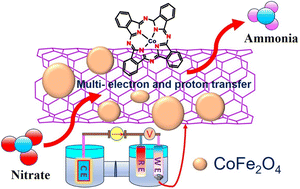
In this study, we developed an optimized catalyst, CoFe2O4/CoPc/CNT, synthesized using 1 mmol of Co(NO3)2·6H2O and 0.125 mmol of FeSO4·7H2O in DMF, along with 0.1 mmol of H2Pc and 40 mg of acid-functionalized CNTs, at 110 °C for 6 h, followed by washing and heat treatment at 500 °C for 90 minutes. Powder X-ray Diffraction (PXRD) and Fourier Transform Infrared (FTIR) Spectroscopy analyses confirm the formation of the CoFe2O4/CoPc/CNT composite. Field Emission Scanning Electron Microscopy (FESEM) combined with Energy Dispersive X-ray Spectroscopy (EDS) shows the uniform distribution of CoFe2O4 over the CNT surface, while High Resolution Transmission Electron Microscopy (HRTEM) reveals the primary deposition of very small CoFe2O4 particles with sizes of approximately 5 nm. HRTEM analysis further reveals the formation of CoPc with a sheet-like morphology. Scanning Transmission Electron Microscopy EDS mapping reveals that the CoPc nanostructures are wrapped around or have grown on the CNT. The uniform dispersion and smaller particle size in the optimized sample are expected to provide a higher density of active sites, enhancing its performance toward electrochemical nitrate reduction (eNO3RR). Electrochemical Impedance Spectroscopy (EIS) measurements show that the optimized sample exhibits the lowest charge transfer resistance among the various composite samples synthesized using different ratios of Co(NO3)2·6H2O (1 mmol) and FeSO4·7H2O (1–0.125 mmol), while maintaining all other reaction conditions constant. The presence of oxygen vacancies in CoFe2O4 and a substantial amount of CoPc in the optimized sample, as revealed by X-ray Photoelectron Spectroscopy (XPS) and PXRD analyses, could enhance the extent of NO3− adsorption and thereby enable efficient NH3 production (∼51.47 mg h−1 cm−2 or 102.94 mg h−1 mg−1cat) at −0.9 V vs. RHE. The optimized catalyst also shows higher selectivity at different NO3− concentrations and applied potentials, demonstrating its superior efficiency toward eNO3RR.
 Please wait while we load your content...


