


 PLATFORM UPDATE:


Redox-active modification of Dawson-type copper molybdate cluster for advanced supercapacitor applications

Abstract
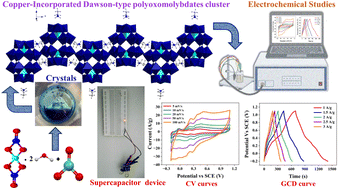
In the pursuit of advanced energy storage systems, cluster materials have garnered considerable attention owing to their ability to integrate complementary electrochemical functionalities. Herein, we report a novel symmetric supercapacitor device based on a Dawson-type polyoxomolybdates cluster featuring a copper-incorporated molybdate core, which is structurally stabilized by dimethylammonium (DMA+) cations, thereby enabling enhanced redox activity and charge storage performance. The polyoxomolybdates cluster [(DMA)3]3+[H9Cu2Mo18O62]3− (1) was synthesized via a facile reflux method. The molecular structure of 1 was elucidated via single-crystal X-ray diffraction, revealing a well-defined 2D network formed by hydrogen bonding. A comprehensive suite of characterization techniques, including FT-IR, P-XRD, TGA, FE-SEM, EDX mapping, XPS, and zeta potential analysis, confirmed the structural integrity, elemental homogeneity, and exceptional stability of the cluster. As evidenced by a highly negative zeta potential (−59.7 mV), the cluster facilitates efficient ion transport and electrolyte accessibility to the electroactive sites. The favourable interfacial environment minimizes resistive losses and improves charge storage. Electrochemical evaluation in a symmetric two-electrode configuration using 1 M H2SO4 as the electrolyte revealed a maximum specific capacitance of 197.27 F g−1 at 5 mV s−1, as determined from cyclic voltammetry. Galvanostatic charge–discharge measurements exhibited highly symmetric triangular profiles with negligible internal resistance, indicative of ideal capacitive behaviour and high coulombic efficiency. A maximum specific capacitance of 80.53 F g−1 was achieved at a current density of 0.5 A g−1, corresponding to an energy density of 18.74 Wh kg−1 and a power density of 332.58 W kg−1. Notably, the device retained 82.70% of its initial capacitance even after 5000 charge–discharge cycles, highlighting its robust cycling stability and potential for practical energy storage applications.
 Please wait while we load your content...


