


Enhancement of second harmonic generation (SHG) in ferrocene-appended T-shaped chromophores: impact of the cyanovinylene moiety with the TICT effect and theoretical insights

Abstract
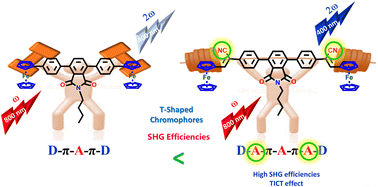
Novel T-shaped multi-donor–π–acceptor ferrocene-conjugated phthalimide and cyanovinylene chromophores 1 and 2 were synthesized and characterized. Single-crystal X-ray diffraction studies of chromophore 2 revealed notable non-covalent interactions and significant twisting from planarity due to the cyanovinylene moiety, which creates a pseudo-centrosymmetric environment and enables SHG activity. Electrochemical studies showed quasi-reversible one-electron transfers with redox potentials shifted by strong acceptor groups in chromophore 2. Fluorescence studies revealed dual emission, which suggests a twisted intramolecular charge transfer (TICT) process. The results of second harmonic generation (SHG) efficiencies revealed that chromophore 1 is 2.2 times and chromophore 2 is 2.6 times higher than the reference, potassium dihydrogen phosphate (KDP). Chromophore 2 showed enhanced SHG efficiency compared to 1 due to the synergistic effects of twisted angles, non-covalent interactions, and the TICT process. Computational calculations were performed to validate the experimental results using the B3LYP/6-31+G** level of theory to analyse the solvatochromism, energy gap and TICT effect.
 Please wait while we load your content...


