


 PLATFORM UPDATE:


Lysosome-targeted Ru(ii)–cyclopentadienyl organometallic anticancer complexes

Abstract
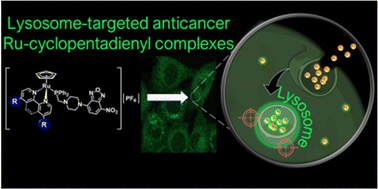
Cancer continues to pose a significant global health burden, prompting ongoing exploration of innovative therapeutic strategies. Ruthenium-based complexes have emerged as promising alternatives to platinum drugs due to their generally favorable pharmacological profiles. In this work, we report the synthesis and characterization of a novel series of fluorescent Ru(II)–cyclopentadienyl organometallic complexes of general formula [Ru(η5-C5H5)(NN)(Ph2P-CH2-pip-NBD)][PF6] (1–5), where NN represents a bipyridine or phenanthroline-based ligand and Ph2P-CH2-pip-NBD is a 4-nitrobenzo-2-oxa-1,3-diazole (NBD)-derived fluorescent phosphane conjugate. Structural characterization confirmed their piano-stool geometry via NMR, FTIR, UV-Vis, fluorescence spectroscopy, and X-ray crystallography (for 1, 3 and 5). The complexes exhibit notable stability in both organic and aqueous media. Cytotoxicity screening across three cancer cell lines (4T1 murine epithelial breast cancer, CT26 murine colon carcinoma, U2OS human osteosarcoma) and one non-cancerous line (3T3 murine embryonic fibroblasts) revealed that complexes 1, 3, and 5 display potent anticancer activity, particularly against U2OS. Fluorescence-based uptake and confocal microscopy demonstrated efficient internalization, primarily through caveolin-mediated endocytosis, and preferential accumulation in lysosomes. Enhanced fluorescence in acidic environments and co-localization with lysosomal markers confirm lysosomal tropism, highlighting the dual role of the NBD fluorophore for traceability and subcellular targeting. Additional mechanistic studies revealed that complexes 1, 3, and 5 induce oxidative stress and trigger apoptosis, suggesting that ROS generation contributes to their cytotoxic activity. These findings establish this class of compounds as promising lysosome-targeting agents.
- This article is part of the themed collections: Articles behind our 2026 journal covers and Celebrating International Women’s Day 2026: Women in Inorganic Chemistry
 Please wait while we load your content...


