


 PLATFORM UPDATE:


Isomorphous metal 1,3,5-benzenetriphosphonates MBP-1 with variable compositions: preparation, crystal structure, and electrochemical properties

Abstract
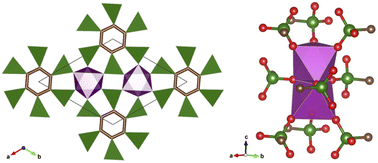
A series of isomorphous compounds obtained from 1,3,5-benzenetriphosphonic acid (BTP or H6btp) and various divalent metal cations, designated as MBP-1 (M = Mn, Zn, Cd, Mg, Ni, Co, and Ca), proved to have non-stoichiometric compositions. The crystal structure of MBP-1 determined by using high-resolution powder X-ray diffraction data reveals face-sharing octahedra dimeric units (M2O9) bridged with parallel stacked BTP units. Although the ideal formula of the framework is [M2H2(btp)], the actual compositions are expressed as [MxH6−2x(btp)]·nH2O (x ≤ 2) accompanied with metal site vacancies. Their non-stoichiometric compositions proved to be controllable with pH of the starting solution. This means that it is possible not only to change the metal cation but also to tune its metal site vacancy retaining the isomorphous structure in MBP-1. This feature of MBP-1 should be useful to understand negative electrode properties of MOF-related materials by systematically comparing the properties of a series of MBP-1 compounds.
 Please wait while we load your content...


