


 PLATFORM UPDATE:


Microwave-assisted aqueous MMA polymerization over TiO2 nanotubes decorated with vanadium complexes
 *ab
Paulina
Parcheta-Szwindowska,
c
Mateusz A.
Baluk,
a
Olga
Chernyayeva,
d
Nicola
Pinna
b
*ab
Paulina
Parcheta-Szwindowska,
c
Mateusz A.
Baluk,
a
Olga
Chernyayeva,
d
Nicola
Pinna
b
Abstract
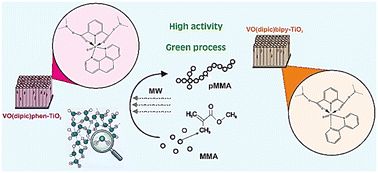
The simultaneous achievement of ultra-high catalytic turnover and precise structural control remains a fundamental challenge in sustainable macromolecular synthesis. Herein, we report a highly efficient, eco-friendly, and energy-minimized microwave-assisted catalytic system for the radical polymerization of methyl methacrylate (MMA). This approach utilizes surface-engineered, supported nanocomposites based on dipicolinate vanadium(IV) complexes (VO(dipic)(L), where L = 2,2′-bipyridine or 1,10-phenanthroline) immobilized on anodized TiO2 nanotubes. By leveraging the interplay between microwave irradiation and the aqueous emulsion environment, these heterogeneous systems exhibit very high catalytic activity. They achieve a nearly twenty-fold enhancement in turnover frequency (TOF > 11 300 h−1) compared to conventional, energy-intensive thermal conditions. The resulting polymers possess narrow molecular weight distributions and a strictly linear microstructure. Post-reaction surface analysis (XPS, SEM) and polymer characterization (FTIR, GPC, NMR) confirm a “grafting-from” mechanism. Multivariate principal component analysis (PCA) statistically confirms that the microwave field acts as a primary driver for a kinetic regime that decouples polymerization rate from termination probability. This work demonstrates that rationally designed heterogeneous catalysts, when coupled with alternative energy sources and aqueous media, can overcome the classical rate-selectivity trade-off, offering a scalable and sustainable route to high-performance functional materials without the ecological burden of traditional transition-metal catalysts.
 Please wait while we load your content...


