


Multi-interfacial engineering of TiO2@TPA–Pt–CuPc heterostructures for highly selective photocatalytic CO2-to-CH4 conversion

Abstract
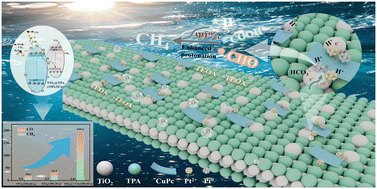
Photocatalytic reduction of CO2 into CH4 represents a sustainable strategy for carbon recycling, yet achieving efficient multi-electron transfer and selective C–H bond formation remains challenging. Herein, we construct a Z-scheme/Schottky dual-interfacial heterostructure by integrating copper phthalocyanine (CuPc) and photodeposited Pt nanoparticles onto a TiO2@TPA hybrid. The TiO2@TPA framework, derived from MIL-125 hydrolysis, provides robust Ti–O–C linkages and intrinsic ligand-to-metal charge transfer (LMCT) channels, while CuPc extends visible-light absorption and facilitates electron migration through its π-conjugated macrocycle. Pt nanoparticles exhibit dual functionality—as electron sinks on TiO2 for multi-electron CO2 reduction and as interfacial bridges promoting charge transfer between TiO2 and CuPc. Comprehensive spectroscopic and photoelectrochemical analyses confirm the establishment of a Z-scheme charge-transfer pathway, efficient carrier separation, and interfacial electronic coupling. The optimized TiO2@TPA(15Pt,5Cu) catalyst achieves a CH4 evolution rate of 199.2 μmol gcat−1 with 99.9% selectivity, markedly outperforming single-component or monometallic counterparts. In situ FTIR spectroscopy reveals successive *COOH, *CO, *CHO, and *CH intermediates, validating the multi-step hydrogenation mechanism. This work extends LMCT-based interfacial engineering toward deep CO2 methanation, offering new insights into the rational design of multi-electron photocatalysts with high selectivity and stability.
 Please wait while we load your content...


