


Redox–acid cooperative bifunctional catalysts comprising dilacunary phosphotungstates and zeolite Hβ for the synthesis of n-butyl levulinate and succinic acid
 *a
and
*a
and
Abstract
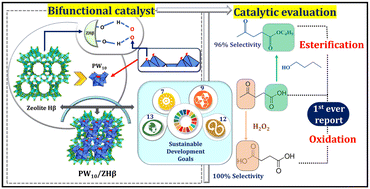
In the present work, a bifunctional heterogeneous catalyst was designed by integrating the redox active centres of lacunary phosphotungstates with the tunable acidity and stability of the zeolite Hβ framework. The catalyst, dilacunary phosphotungstate anchored to zeolite Hβ, was synthesized and characterized using NH3-TPD, EDX, FTIR, BET, XRD, 29Si NMR and HRTEM analyses. The proposed interaction between the redox-active PW10 units and the surface silanol groups of zeolite Hβ enabled dual catalytic functionality. This efficiently catalyses both the esterification and the oxidation of levulinic acid under mild and green conditions for the selective synthesis of n-butyl levulinate (96% selectivity) and succinic acid (100% selectivity), respectively. Notably, this study represents the first successful effort to achieve complete selectivity toward succinic acid. Validation of the kinetic mechanism was performed, followed by recycling experiments. The alignment of this work with sustainable development goals highlights its broader societal relevance, positioning the catalyst as a promising platform for future green and energy-efficient transformations.
 Please wait while we load your content...


