


 PLATFORM UPDATE:


Magnesium–iron modified sludge biochar for methyl orange removal via adsorption and periodate-based advanced oxidation
 a
a
Abstract
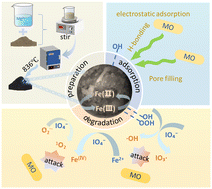
The extensive discharge of dye pollutants poses a severe threat to aquatic ecological systems and human health, necessitating the urgent development of efficient dye wastewater treatment technologies that simultaneously enable waste valorization. In this study, a low-cost and environmentally friendly biochar (SBC-a) was synthesized and applied for the removal of methyl orange (MO) from aqueous solutions. Comprehensive characterization confirmed the physicochemical properties of the as-prepared biochar. Adsorption experiments revealed that MO adsorption onto SBC-a followed the pseudo-second-order kinetic model, indicating a chemisorption-dominated process with heterogeneous surface interactions. Under optimized acidic conditions (pH = 3.0), with an SBC-a dosage of 0.15 g L−1 and sodium periodate concentration of 0.8 mM, the adsorption–oxidation system achieved a MO removal efficiency of 93.3%. Radical quenching experiments demonstrated that oxygen-containing functional groups on the biochar surface, in conjunction with the Fe2+/Fe3+ redox cycle, synergistically activated sodium periodate to generate multiple reactive species, including 1O2, Fe(IV), IO3·, and O2˙−. Furthermore, liquid chromatography-mass spectrometry (LC-MS) analysis enabled the identification of intermediate products and the proposal of four plausible degradation pathways. This work presents an efficient heterogeneous periodate-based adsorption–oxidation system, highlighting its promising potential for practical applications in the treatment of dyeing and printing wastewater.
 Please wait while we load your content...


