


 PLATFORM UPDATE:


Sustainable base-mediated chemical upcycling of waste polycarbonates to fine chemicals
 †ac
Nagaraju
Barsu
*ac
†ac
Nagaraju
Barsu
*ac
Abstract
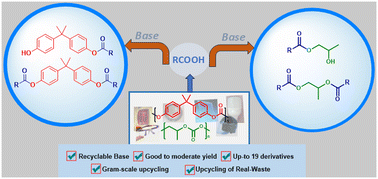
The widespread use and environmental persistence of polycarbonates (PCs), particularly bisphenol A-derived polycarbonate (PC-BPA), have created an urgent need for sustainable solutions. Herein, we report a DMAP-mediated, metal-free upcycling approach that directly converts post-consumer PC-BPA and polypropylene carbonate (PPC) waste into valuable aromatic esters under mild conditions. Using 4-dimethylaminopyridine (DMAP) as a nucleophilic base, we demonstrate the efficient depolymerization of waste polycarbonates in the presence of carboxylic acids, affording di-aryl and di-aryl diester products in excellent yields. The protocol tolerates a broad scope of benzoic and phenylacetic acid derivatives, including both electron-donating and electron-withdrawing substituents. Real-life PC-BPA waste sources, such as CDs, safety goggles, roof sheets, and LED bulbs, were successfully upcycled, and the method was scalable to gram-scale reactions. Mechanistic investigations, including DFT studies and control and time-course experiments, suggest the formation of acid–DMAP ion pairs and polycarbonate-derived carbamate intermediates, enabling stepwise depolymerization. The base recyclability and activity experiments demonstrate that this strategy is sustainable and promising for converting plastic waste into value-added esters.
 Please wait while we load your content...


