


 PLATFORM UPDATE:


Self-propelled MOF micromotors: a smart solution for antibiotic pollution and resistance control

Abstract
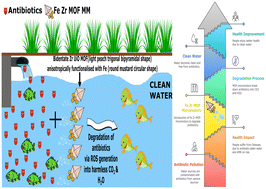
The metalation of metal–organic frameworks (MOFs) is one of the most effective tools for post-synthetic modification (PSM) to expand their application horizon. The anisotropic metalation of MOFs results in the formation of Janus particles (JPs) that can act as self-propelled micromotors (MMs) and open a new avenue for applications, such as drug delivery, sensing, environmental remediation, and catalysis. Antibiotic waste, discharged from industries or excreted by humans or animals due to the overuse of antibiotics in disease treatment, leads to resistance development, referred to as AMR (antimicrobial resistance), in bacteria that have previously encountered these antibiotics. By the anisotropic metalation (type I) of a bidentate Zr UiO MOF, consisting of a biphenyl dicarboxylic acid (H2bpdc) ligand and a 2,2′-bipyridine-5,5′-dicarboxylic acid (H2bpydc) linker, we solvothermally synthesized a self-propelled Fe Zr MOF MM (micromotor). Herein, the pyridine-based carboxylic linker will enable the addition of Fe anisotropically, without perturbing the UiO framework, to form the self-propelled Fe Zr MOF MM that could achieve an optimum linear speed of 197 μm s−1 in the presence of H2O2 as a fuel and motion-stimulating agent (MSA). FTIR spectroscopy, XPS, XRD, EDAX (elemental data analysis), FESEM, HRTEM, porosity analysis and TGA data confirm the formation of the Fe Zr MOF MM, keeping the original crystal structure of the bidentate Zr UiO MOF intact. The developed Fe Zr MOF MM was able to degrade 60% of amoxicillin, a penicillin group of antibiotics, within 25 min in water under ambient conditions without any external factors, such as stirring. The compositional analysis of the degraded products by HPLC and HRMS also proved that the β lactam group was completely destroyed and low-molecular-weight molecules were present in the degraded products. XRD and XPS analyses of the Fe Zr MOF MM and the morphological images obtained by FESEM confirmed that the structural integrity of the MM remained unaltered after chemotactic catalytic activity. Thus, Fe Zr MOF MM is a self-propelling material that operates on a “degrade as it moves” principle toward amoxicillin, a penicillin-class antibiotic. It functions as an energy-efficient catalyst for the chemotactic degradation of penicillin-group antibiotics and holds promise as a potent, energy-saving tool in the fight against the growing threat of AMR.
 Please wait while we load your content...


