


 PLATFORM UPDATE:


The influence of Ce incorporation on integrated CO2 capture and in situ methanation performance of Ni/CaO–Al2O3 dual functional materials
 *a
*a
Abstract
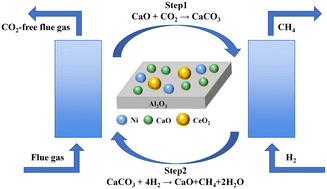
Integrated CO2 capture and utilization (ICCU) on the basis of dual functional materials (DFMs) represents a highly promising technology. It demonstrates remarkable advantages through streamlining the system configuration and reducing the process costs. A major challenge in carbon capture and methanation is the growth and agglomeration of nickel particles in materials. In this research, Ce-incorporated Ni/CaO–Al2O3 DFMs were synthesized to address this issue and further enhance the CH4 yield. The introduction of Ce efficiently suppressed the clustering of nickel particles and optimized the pore structure of materials. The methanation performance of synthesized materials was systematically evaluated under integrated carbon capture and methanation conditions. The experimental findings demonstrated that the synthesized NiCe0.5/CaO–Al2O3 exhibited optimal carbon capture capabilities and catalytic activities at 450 °C. Specifically, the material demonstrated a CO2 uptake of 2.28 mmol g−1, while the CH4 yield reached 1.67 mmol g−1. The stability experiments revealed that the DFMs maintained a relatively high level of activity even after undergoing 10 cycles. Characterization and performance tests indicated that the incorporation of Ce facilitated CO2 activation, improved the electron density around Ni sites, increased the exposure and dispersion uniformity of Ni active sites on the surface and effectively suppressed the growth and sintering of Ni particles, thereby leading to an overall improvement in material performance. This study elucidates the specific promoting role of Ce doping in the performance of Ni/CaO–Al2O3 materials during the ICCU process, providing a basis for the design of more efficient DFMs.
 Please wait while we load your content...


