


 PLATFORM UPDATE:


Metal–ligand cooperative strategy of a Zn-catalyst for multicomponent synthesis of highly substituted pyrazolines, pyrimidines, and quinolines: a combined experimental and DFT optimized study

Abstract
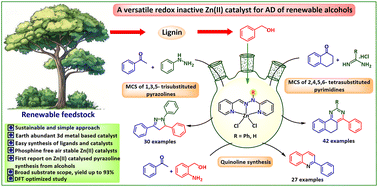
In this study, we disclose a Zn(II)-catalysed metal-ligand cooperative approach that converts renewable primary alcohols into highly substituted N-heterocycles via acceptor-less dehydrogenation. A well-defined Zn(II) complex, C1, supported by the NNN pincer ligand (E)-2-((2-(pyridin-2-yl)hydrazineylidene)methyl)pyridine (L1), was prepared and characterized by IR, UV-vis, 1H and 13C NMR spectroscopy, HRMS, and single-crystal X-ray diffraction. Complex C1 efficiently promotes a one-pot, three-component synthesis of 1,3,5-trisubstituted-pyrazolines from aromatic primary alcohols, aromatic ketones, and phenylhydrazine. The scope of C1 was further demonstrated in the multicomponent construction of 2,4,5,6-tetrasubstituted pyrimidines from primary alcohols, challenging cyclic ketones, and various amidine hydrochlorides, as well as in the dehydrogenative coupling of 2-aminobenzyl alcohol with aromatic ketones to furnish quinolines. Overall, 30 pyrazolines, 42 pyrimidines, and 27 quinolines were obtained in good yields. Control experiments, HRMS study, and DFT calculations collectively support a reaction pathway in which alcohol dehydrogenation proceeds through a metal–ligand cooperative mechanism.
 Please wait while we load your content...


