


Acidic site-assisted catalytic oxidation of 5-hydroxymethylfurfural to 2,5-furandicarboxylic acid with Ru–Mn supported on modified ZSM-5 under aqueous conditions

Abstract
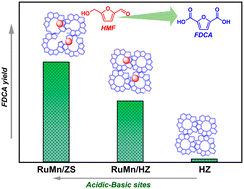
A series of Ru–Mn catalysts supported on desilicated ZSM-5 (RuMn/ZS) are prepared and investigated for the oxidation of HMF to FDCA under aqueous conditions without an external base. RuMn/ZS shows a two-fold higher catalytic activity than Ru–Mn supported on the parent ZSM-5 (RuMn/HZ), giving the highest FDCA yield of 76.7% under optimised reaction conditions. N2-sorption analysis indicates that RuMn/ZS possesses a 1.22 times higher total surface area (448 m2 g−1) and 2.72 and 6.72 times higher mesopore surface area (207 m2 g−1) and mesopore volume (0.942 cm3 g−1) than the parent RuMn/HZ due to the desilication. High-resolution transmission electron microscopy (HRTEM) and elemental mapping indicate that RuMn/ZS possesses relatively smaller particle sizes (1.7 nm) with high dispersion of Ru and Mn. NH3 and CO2-temperature programmed desorption studies show that RuMn/ZS has a 2 times higher amount of total acidic sites and a 1.79 times higher amount of total basic sites compared to RuMn/HZ. In addition, RuMn/ZS also possesses a balance ratio of acidic to basic sites (3.08) with optimal amounts compared to other catalysts employed in this study. Furthermore, an in situ diffuse reflectance infrared Fourier transform (DRIFT) study using ammonia, pyridine, and CO2 as probe molecules discloses that RuMn/ZS possesses relatively stronger Lewis acidic sites and stronger basic sites than RuMn/HZ. HMF adsorbed RuMn/ZS diffuse reflectance ultraviolet-visible and DRIFT spectra substantiate the stronger Lewis acidity and basicity than those of RuMn/HZ. Poisoning studies with additives, such as KSCN, further substantiate the crucial primary role of Lewis acidic sites in efficiently catalysing the HMF oxidation reaction. RuMn/ZS is recyclable for three runs with no notable activity loss.
 Please wait while we load your content...


