


 PLATFORM UPDATE:


Engineering coordination bonds for bioinspired responsive polymers

Abstract
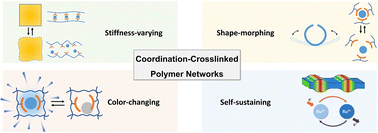
Responsive polymeric materials capable of converting weak and heterogeneous environmental cues into adaptive macroscopic functions are essential for emerging technologies spanning soft robotics, sensing, biointerfaces, and autonomous systems. Coordination-crosslinked polymer networks (CCPNs), constructed by embedding dynamic metal–ligand interactions into polymer matrices, have emerged as a powerful materials platform for this purpose, owing to the unique tunability, reversibility, and multifunctionality of coordination bonds. Unlike conventional covalent or other supramolecular crosslinks, coordination bonds provide continuously adjustable bond strength, well-defined geometry, stimulus-sensitive equilibria, and access to electronic, redox, and catalytic transitions, enabling direct transduction of physical and chemical stimuli into mechanical, optical, and morphological responses. Despite rapid progress, a unified understanding that links coordination chemistry at the molecular level to material responsiveness across length and time scales remains lacking. In this review, we systematically examine how the intrinsic properties of coordination bonds give rise to material responsiveness in CCPNs. We first introduce fundamental coordination chemistry concepts relevant to responsive network design and discuss how these factors govern bond dynamicity, exchange kinetics, and stimulus sensitivity within polymer networks. We then analyse how coordination dynamics manifest as macroscopic responses, with a focus on stiffness variation, optical and chromic switching, shape memory and actuation, and life-like homeostatic behaviors driven by non-equilibrium bond cycling. Moving beyond single-interaction systems, we highlight recent advances in bond coupling strategies, where multiple coordination motifs or coordination bonds integrated with other supramolecular bonds, dynamic covalent bonds, or mechanical bonds generate hierarchical relaxation, orthogonal responsiveness, and synergistic function expression reminiscent of biological materials. Finally, we discuss key challenges and outline future opportunities for transforming coordination chemistry from a crosslinking motif into a molecular-level control framework for engineering responsive and life-like soft materials.
 Please wait while we load your content...


