


 PLATFORM UPDATE:


Processable microporous membranes: emerging platforms for separation technologies
 *d
and
Jingwei
Hou
*be
*d
and
Jingwei
Hou
*be
Abstract
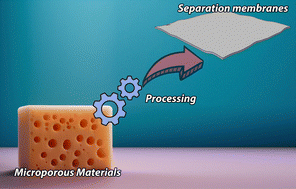
Processability has emerged as a critical requirement for translating microporous materials into scalable membrane technologies, yet many porous frameworks remain difficult to fabricate as large-area, defect-free membranes. This review adopts a processability-centred perspective to examine recent advances in purely organic microporous membranes and MOF-based membranes, highlighting how molecular design, interfacial engineering, and melt- or solution-processing enable tunable porosity, improved mechanical fragility, and scalable fabrication. It further delineates how amorphous microporous organic polymers, crystalline microporous organic frameworks, polycrystalline MOFs, MOF–polymer composites, and MOF-derived glasses differ in film-forming capabilities, structural stabilities, and manufacturing feasibility, thereby revealing fundamental trade-offs between structural precision and processability. Emerging strategies—such as in situ crystallisation, solution processability, polymer–MOF hybridisation, and melt-processable MOF glasses—offer new pathways to mitigate long-standing challenges related to defect control, mechanical robustness and limited scalability. Taken together, these advances establish design principles and processing pathways for next-generation microporous membranes, and point toward practical opportunities for industrial implementation in gas separation, solvent nanofiltration, water purification, and energy-related processes.
 Please wait while we load your content...


