


 PLATFORM UPDATE:


First-principles study on the stabilization of P2-Na2/3Ni1/3Mn2/3O2 by lithium doping

Abstract
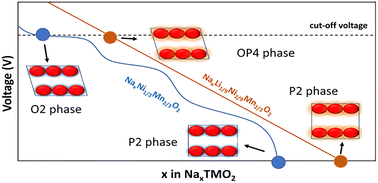
Lithium doping can effectively mitigate the rapid capacity fade of layered oxide cathode materials for sodium-ion batteries, but the underlying mechanism remains unclear. In this study, by using first-principles calculations, we systematically investigate Li doping effects on the phase transition and surface properties of P2-NaxNi1/3Mn2/3O2 (0 < x < 1) during charge–discharge processes and reveal the following: (i) Li doping elevates the average operating voltage, enabling the material to maintain a higher sodium content at the practical upper-cutoff voltage. This higher sodium content thermodynamically stabilizes the layered structure, which is the fundamental reason for the redirected phase transition pathway from P2 → O2 to P2 → OP4. The associated activation of oxygen redox at a high SOC (state of charge) reduces the net charge on oxygen, thereby decreasing the electrostatic repulsion between the oxygen layers as a consequential effect. (ii) Li migration from the transition metal layer to the sodium layer can act as a structural pillar to prevent particle cracking, but this reversible migration between the two layers can only occur within a certain SOC range. (iii) The Na+/vacancy ordering is disrupted, leading to a solid–solution behavior during sodium insertion and extraction. These factors are likely the key reasons for the improved cycling stability, although surface oxygen exhibits stronger oxidizability at a high SOC, which may trigger severe interfacial side reactions. Therefore, it is necessary to strictly control the amount of sodium extraction to avoid over-oxidation.
 Please wait while we load your content...


