


 PLATFORM UPDATE:


Synergistic modulation of composite donors and π-spacers in porphyrin sensitizers for enhanced charge transfer and photovoltaic efficiency: a DFT/TD-DFT study
 a
a
Abstract
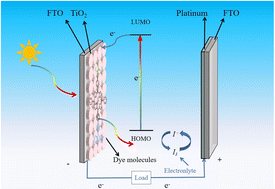
Molecular engineering of porphyrin sensitizers is an effective strategy for improving the power conversion efficiency (PCE) of dye-sensitized solar cells (DSSCs). In this work, the synergistic effects of composite donor engineering and π-spacer modulation on the electronic structure, interfacial charge transfer, and photovoltaic performance of D–π–A porphyrin dyes were systematically investigated using DFT and TD-DFT calculations. Five sensitizers (L, T, T-L, TO-L, and T-LD) were designed by combining triphenylamine, indoline, methoxy modification, and acetylene π-bridges. The calculated results reveal that the composite donor strategy effectively improves energy-level alignment, promotes directional intramolecular charge transfer, and suppresses charge recombination. Among all sensitizers, the methoxy-modified dye TO-L exhibits the best overall photovoltaic performance, with the most favorable electron injection driving force (ΔGin = −2.24 eV), a low regeneration energy loss (ΔGre = 0.06 eV), efficient interfacial coupling, and a high theoretical PCE of 10.10%. Further analysis based on the dye–TiO2 interface demonstrates that conduction-band upshifts and interfacial dipole effects play critical roles in determining the balance between electron injection and open-circuit voltage. In contrast, the acetylene-bridged dye T-LD shows the largest absorption redshift and highest JSC owing to extended π-conjugation, but excessive electron delocalization weakens the actual injection driving force (ΔG0 = 0.28 eV) and increases reorganization energy, resulting in reduced VOC and PCE. These results reveal a clear spectral–voltage trade-off in highly conjugated porphyrin systems and demonstrate that synergistic optimization of donor strength, conduction-band alignment, and interfacial charge-transfer dynamics is more important than simply extending π-conjugation. This work provides valuable theoretical guidance for the rational design of high-efficiency porphyrin sensitizers.
 Please wait while we load your content...


