


 PLATFORM UPDATE:


Weak interactions in mixed symmetric and asymmetric self-assembled monolayers for perovskite solar cells: a classical molecular dynamics view
 a
and
Ru
Li
*a
a
and
Ru
Li
*a
Abstract
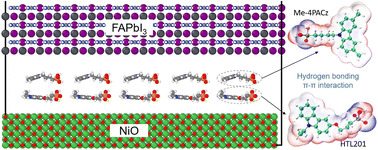
Self-assembled monolayers (SAMs) serve as critical hole-transporting components at the buried interfaces of high-performance inverted perovskite solar cells (PSCs). Herein, comprehensive classical molecular dynamics (MD) simulations were performed to elucidate the intricate non-covalent interactions governing the co-assembly of symmetric and asymmetric SAM configurations. Our molecular insights reveal that the asymmetric SAMs possess a pronounced dipole moment that promotes robust interfacial hydrogen bonding while simultaneously mitigating homo molecular π–π packing. Crucially, blending symmetric and asymmetric SAMs further decouples the π–π interactions, thereby synergistically boosting anchoring stability and maximizing surface coverage. Overall, these findings demonstrate that precise manipulation of weak non-covalent interactions within SAM networks represents a potent and generalizable paradigm for optimizing interfacial properties in advanced optoelectronics.
 Please wait while we load your content...


