


 PLATFORM UPDATE:


Ability of carbenes to act as Lewis bases within a halogen bond

Abstract
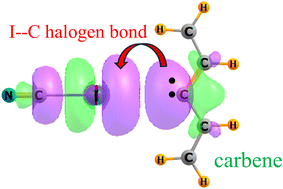
A halogen bond is formed by a wide range of divalent CR2 carbenes with ICN as the Lewis acid, and the results are examined via DFT calculations. These carbenes form much stronger halogen bonds than more common Lewis bases such as NH3 and OH2. The binding occurs through the carbene C lone pair and is enhanced if the central C is covalently attached to C on the R substituent, as compared to O or N. Interaction energies are as high as 30 kcal mol−1, and the C⋯I bond contains a certain degree of covalent character. The two lone pairs on the C atom of the carbene, when connected through dative bonds to units such as NH3 and OH2, make this C especially strongly nucleophilic, enough so as to partially extract the I from the ICN unit. The carbene halogen bonds have all of the characteristics of their classic counterparts, including a high dependence upon Coulombic interaction.
 Please wait while we load your content...


