


 PLATFORM UPDATE:


Powdered carboxymethyl chitosan–engineered nZVI nanocomposites for rapid and ultrahigh-capacity Cr(vi) removal
 bc
Nisar
Ullah
*ae
bc
Nisar
Ullah
*ae
Abstract
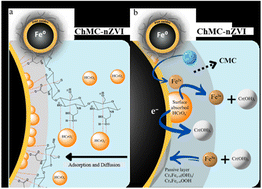
The aggregation and surface passivation of nanoscale zero-valent iron (nZVI) significantly limit its practical efficiency in aqueous heavy metal remediation. Herein, we report the synthesis of carboxymethyl chitosan–engineered nZVI (ChMC–nZVI) nanocomposites in a free powder form via an in situ borohydride reduction method to enhance particle stability, surface accessibility, and Cr(VI) removal performance. Structural and interfacial characterization studies (XRD, TEM, SEM–EDS, and FTIR) confirm the formation of a core–shell Fe0 structure uniformly coated with ChMC through carboxylate-mediated coordination, which suppresses agglomeration and mitigates surface oxidation. The optimized nanocomposite (15 wt% ChMC) achieved complete removal of 50 mg L−1 Cr(VI) at pH 3 within 180 min using a low adsorbent dosage (0.16 g L−1). A maximum experimental adsorption capacity of 439.55 mg g−1 was obtained at higher initial concentration, while Langmuir modeling yielded a maximum monolayer capacity of 424.46 mg g−1, indicating homogeneous surface adsorption. Kinetic analysis revealed rapid uptake, with ∼40% removal within the first 5 min, and excellent agreement with the pseudo-second-order model (R2 > 0.99), suggesting a chemisorption-dominated redox mechanism. The enhanced performance is attributed to the synergistic effects of steric stabilization, improved mass transfer in powder form, and facilitated electron transfer between Fe0/Fe2+ and Cr(VI). This study demonstrates that polymer-engineered nZVI nanocomposites offer a highly efficient and structurally robust platform for advanced water remediation applications.
 Please wait while we load your content...


