


Electronic regulation of the first-coordination-shell environments in Mn-based single-atom sites for electrochemical NO reduction: a density functional theory study
 *a
*a
Abstract
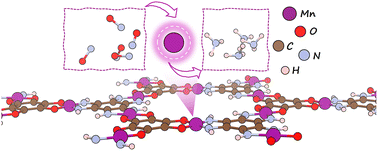
Ammonia is both a key basic chemical and an ideal hydrogen-storage material. Compared with the energy-consuming Haber–Bosch process, the electrochemical nitric oxide reduction reaction (NORR) is regarded as a feasible way to produce NH3 under mild conditions owing to its easy substrate activation, high reactant solubility, and the potential for converting environmental pollutants into value-added resources. In this work, we performed spin-polarized density functional theory calculations to thoroughly explore ten MnA2B2 coordination environments derived from the two-dimensional Mn3(HXBHYB) monolayer and uncovered the role of the first coordination layer in tuning the stability, activity, and selectivity of the Mn-based single-atom sites toward the NORR. The screening based on the formation energy and dissolution potential indicated that the N/O-rich coordination environment can effectively maintain the thermodynamic stability and electrochemical durability of Mn sites. NO prefers to adopt N-end adsorption on all candidate configurations. The adsorption free energy of *NO shows a strong linear correlation with the interfacial charge transfer and Mn d-band center, which implied that the ligand-induced electronic effect is one of the important factors affecting substrate adsorption and activation. Among the stable configurations, both MnN2O2 and MnO4 passed the thermodynamic screening of the first step *NO → *HNO. However, MnN2O2 exhibited a relatively low limiting potential (−0.17 V vs. RHE), a more energetically favorable reaction mechanism, and a stronger ability to suppress the N2/N2O side reaction and HER. Thus, the fine-tuning of electronic modulation within the first coordination sphere of two-dimensional manganese-based conductive MOFs provides a theoretical basis for the rational design of highly efficient and low-cost NORR catalysts.
 Please wait while we load your content...


