


 PLATFORM UPDATE:


Dopant-driven electronic and lattice softening enables transport-coupled CO2 reduction in β-Ag2Se

Abstract
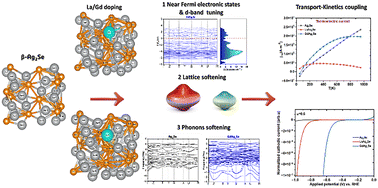
Lanthanide-driven lattice softening provides an integrated framework to couple electronic transport, phonon dynamics, and surface reaction kinetics in β-Ag2Se. First-principles calculations reveal that La and Gd incorporation induces a near-metallic electronic structure, where dopant d/f states hybridize with Se p orbitals to generate a continuous density of states at the Fermi level, enhancing carrier delocalization and electrical transport. This electronic reorganization weakens lattice restoring forces, reducing the bulk modulus from ∼77 GPa in pristine Ag2Se to ∼23 GPa in LaAg2Se before partially recovering to ∼52 GPa in GdAg2Se. The softened lattice exhibits low-frequency acoustic phonon behavior and increased polarizability, indicative of stronger electron–phonon coupling and modified thermoelectric transport characteristics. Such vibrational flexibility simultaneously facilitates CO2 activation. Climbing-image nudged elastic band calculations show a significant reduction in the *COOH formation barrier in doped systems, arising from cooperative lattice relaxation and metallic electron donation that stabilize the transition state. Despite elastic softening, positive stiffness eigenvalues and controlled elastic anisotropy confirm mechanical stability. The coexistence of metallic conductivity, lattice polarizability, and soft phonon modes enables dynamic adsorbate accommodation while preserving transport functionality. These findings establish lanthanide-modified β-Ag2Se as a transport-coupled platform in which lattice softness, carrier density, and phonon engineering jointly govern thermoelectric behavior and catalytic reactivity.
 Please wait while we load your content...


