


Role of the heavy nonmagnetic Cd cation in magnetic anisotropy of d0 ferromagnetic monolayer TiCdO4
 *a
and
*a
and
Abstract
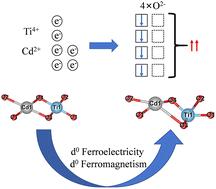
In d0 ferromagnets, where magnetism arises from spin-polarized p orbitals of light anions, magnetocrystalline anisotropy energy (MAE) is generally weak due to limited spin–orbit coupling (SOC) in the magnetic states. In this work, we investigate the magnetic anisotropy in the two-dimensional d0 ferromagnetic multiferroic monolayer TiCdO4 using first-principles calculations, revealing a novel mechanism for the emergence of MAE. We demonstrate that the heavy nonmagnetic cation Cd, despite its 4d states being well below the Fermi level, plays a crucial role in mediating SOC effects. The hybridization between Cd d states and O 2p orbitals near the Fermi level enhances SOC between Cd and O, thereby contributing to the MAE. Notably, this hybridization induces substantial SOC from Cd to the O p orbitals, which drives the MAE in this d0 ferromagnet. Furthermore, we reveal that the ferroelectric phase transition from the centrosymmetric metallic P2/m phase to the polar insulating P1 phase strengthens a specific Cd–O bond due to a reduced bond length, leading to an increased contribution to the MAE from a particular oxygen site. These findings provide novel theoretical insights into magnetic anisotropy in d0 ferromagnetic multiferroics, demonstrating how the interplay between heavy nonmagnetic cations and oxygen p orbitals can induce significant MAE through orbital hybridization. Our results suggest a new pathway for controlling MAE in d0 systems by tuning cation–anion interactions, advancing the design of multiferroic materials.
 Please wait while we load your content...


