Synergistic effects of K-atom rattling, anisotropy, and antibonding states on high thermoelectric performance in KAuSe2

Abstract

This study reveals the synergistic roles of structural rattling, anisotropy, and antibonding states in KAuSe2 using first-principles calculations and Boltzmann transport theory. The strongly covalent chain [AuSe2] and weakly bonded K atoms induce rattling vibrations, and together with antibonding states weaken chemical bonding near the band edges, thereby enhancing lattice anharmonicity and phonon scattering, leading to an ultralow lattice thermal conductivity (κL) of 0.40 W m−1 K−1 along the a-direction at 700 K. Notably, n-type KAuSe2 achieves a maximum zT of 1.06 along the c-direction, while p-type KAuSe2 shows its peak zT of 0.99 along the a-direction, demonstrating strong orientation-dependent thermoelectric optimization. These findings highlight the cooperative control of rattling, anisotropy, and antibonding states for high-performance thermoelectrics.
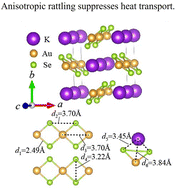
Graphical abstract: Synergistic effects of K-atom rattling, anisotropy, and antibonding states on high thermoelectric performance in KAuSe2

Supplementary files

Transparent peer review

To support increased transparency, we offer authors the option to publish the peer review history alongside their article.

View this article’s peer review history

Article information

Article type
Paper
Submitted
08 Mar 2026
Accepted
02 Jun 2026
First published
02 Jun 2026

Phys. Chem. Chem. Phys., 2026, Advance Article

Synergistic effects of K-atom rattling, anisotropy, and antibonding states on high thermoelectric performance in KAuSe2

J. Wang, L. Shang, S. Zeng, Y. Wu and C. Liu, Phys. Chem. Chem. Phys., 2026, Advance Article , DOI: 10.1039/D6CP00855K

To request permission to reproduce material from this article, please go to the Copyright Clearance Center request page.

If you are an author contributing to an RSC publication, you do not need to request permission provided correct acknowledgement is given.

If you are the author of this article, you do not need to request permission to reproduce figures and diagrams provided correct acknowledgement is given. If you want to reproduce the whole article in a third-party publication (excluding your thesis/dissertation for which permission is not required) please go to the Copyright Clearance Center request page.

Read more about how to correctly acknowledge RSC content.

Social activity

Spotlight

Advertisements